What happens after a delivery dispute, vehicle incident, or employee concern when you review the footage and it does not show enough to explain what happened?
Maybe the footage is too dark, the camera is too far away, or an important area is completely out of view.
For Hawaii business owners and property managers, that can mean an incident has already happened, but the video still does not provide the answers they need.
The cameras may be working exactly as installed, but the coverage plan may no longer show what the property needs to see.
Knowing where your system falls short can help you decide whether a camera replacement, upgrade, or new installation would provide better visibility.
When Footage Leaves More Questions Than Answers
Imagine reviewing footage after a delivery dispute, only to find that the camera captured the loading area but missed the actual drop-off point.
Or a vehicle enters the parking lot, but the recording does not show enough detail to answer a basic question about what happened.
Situations like these can happen even when cameras appear to be working properly. Common problems include:
- Missed activity: An incident happens outside the camera’s field of view.
- Unclear footage: Faces, vehicles, deliveries, or other important details are too distant or blurry to identify.
- Poor nighttime visibility: Important details are lost in darkness or uneven lighting.
- Incomplete recordings: Footage shows only part of an event, leaving important questions unanswered.
When this happens, reviewing security footage becomes more time-consuming and less useful. A well-planned camera system should give your team clearer information when they need to understand what happened.
Common Coverage Problems at Commercial Properties
Coverage problems are not always caused by faulty equipment. They can develop as buildings change, operations expand, or existing camera locations become less effective.
Common issues include:
- Blind spots around entrances, parking areas, loading zones, and vehicle gates.
- Poor camera positioning that makes important details too distant or difficult to see.
- Challenging lighting caused by glare, shadows, or inadequate nighttime visibility.
- Outdated coverage plans that no longer reflect how employees, customers, and vehicles use the property.
- Uncovered changes, including new doors, tenants, storage areas, or parking arrangements.
- Recording limitations that make footage difficult to find, review, or retain for the needed period.
For example, a commercial building may add a secondary employee entrance while keeping its original camera layout. The existing cameras may still cover the hallway, but activity at the new doorway could remain out of view.
This is why reviewing the overall coverage plan can be more useful than simply adding another camera.
Good Coverage Starts With What the Property Needs to See
More cameras do not automatically mean better coverage.
A retail center, warehouse, office building, and industrial facility each have different activities to monitor. The right camera plan should reflect those differences.
Start by identifying the areas where visibility matters most:
- Main and employee entrances: Review arrivals, departures, visitor activity, and deliveries.
- Parking areas, vehicle gates, and loading zones: Monitor vehicle movement and important entry or delivery points.
- Hallways and restricted spaces: Maintain visibility around equipment rooms, storage areas, and service corridors.
- Customer-facing and high-traffic areas: Capture useful context when reviewing interactions or daily activity.
The right approach also depends on what the footage needs to show. A wide view may help monitor general activity across a parking lot, while a more focused view may be needed at a vehicle entrance or loading point.
Camera placement, viewing angle, lighting, image quality, and recording needs should all be considered together.
Access Hardware Inc. provides commercial security camera and video monitoring systems designed around the layout and operational needs of Hawaii properties.
Cameras Can Provide Better Context at Priority Entry Points
Cameras can be planned around the doors, gates, and areas where people and vehicles regularly enter or leave a property.
For example, a camera near an access-controlled employee entrance may help managers visually review activity at that doorway. Coverage near a parking gate can provide similar context when questions arise about vehicle entry.
Depending on the facility, camera planning may complement existing systems such as:
- Card Access Control Systems for employee entrances and restricted areas.
- Parking Controls and RFID for managed vehicle entry.
- Telephone Entry and Intercom Systems for visitor communication and access.
Not every property needs an integrated system. What matters is choosing an approach that supports daily operations without adding unnecessary complexity.
Hawaii Conditions Can Affect Camera Performance
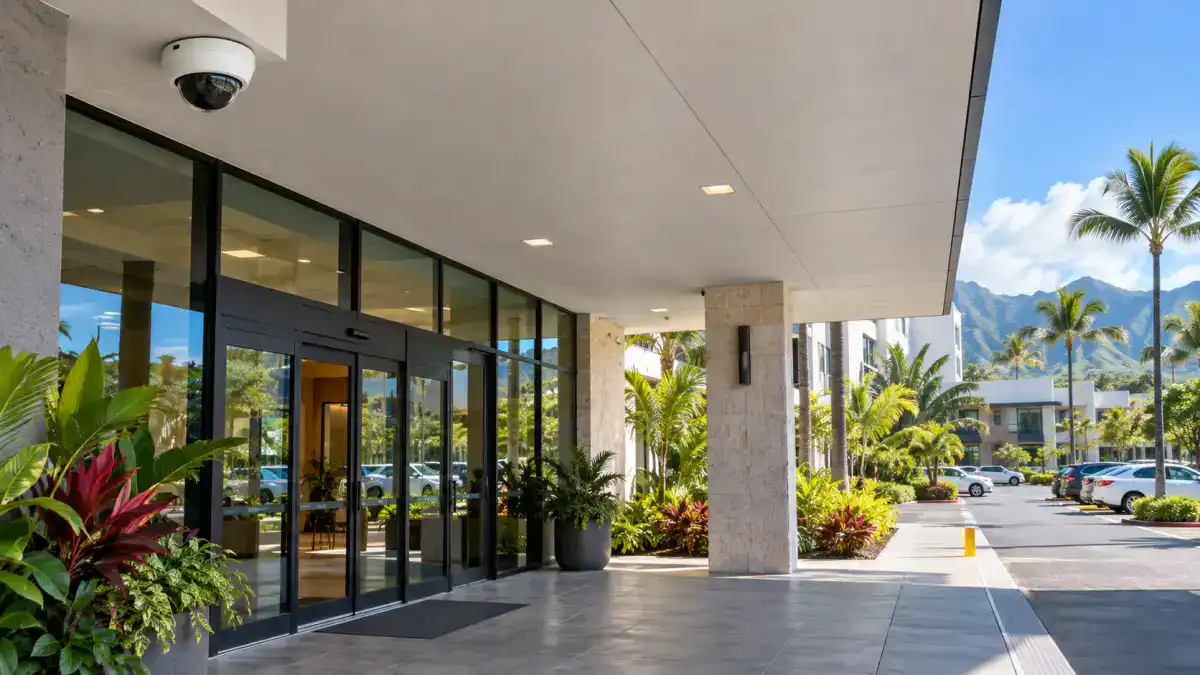
Outdoor security cameras in Hawaii face conditions that can affect visibility and equipment reliability. An exposed coastal entrance, for example, has different needs from a protected interior hallway.
Important factors include:
- Sun glare: Strong sunlight and reflections can make footage difficult to see clearly.
- Wind-driven rain: Rain can temporarily obscure important camera views.
- Salt air and humidity: Coastal exposure can contribute to corrosion and equipment wear.
- Wind exposure: Outdoor cameras need secure mounting suited to their location.
- Changing light: Entrances and parking areas may have very different visibility throughout the day and night.
Consider a west-facing parking entrance. It may provide a clear view in the morning but experience strong glare later in the afternoon. A camera that works well indoors may also be unsuitable for an exposed outdoor location.
Accounting for these conditions during planning helps ensure the selected equipment and coverage approach fit the environment.
When It May Be Time to Upgrade the Camera Plan
If your property has changed since the cameras were installed, its coverage may need to change with it.
Signs it may be time to reassess include:
- Recurring blind spots: Important activity continues to happen outside existing camera views.
- Property changes: Renovations, new tenants, or expanded operations have created additional coverage needs.
- Difficult footage review: Your team spends too much time locating recordings or trying to make out important details.
- New priority areas: Entrances, parking spaces, loading zones, or restricted areas now require attention.
- Limited expansion options: Older equipment or system limitations make it difficult to add cameras or improve recording capabilities.
In some cases, replacing a few cameras or expanding existing coverage may be enough. For properties with several gaps or outdated equipment, a broader upgrade or new installation may make more sense.
The best choice depends on what the current system can support and how the property operates today.
A Practical Next Step: Review Your Coverage
If your security cameras are not giving you useful answers, start by finding out where coverage can improve.
Established in 1989, Access Hardware Inc. helps Hawaii property managers, business owners, and facility operators plan security camera systems around their needs.
An on-site assessment can help identify:
- Existing camera coverage and priority areas
- Blind spots, lighting, and environmental conditions
- Daily activity and changes in property use
- Recording needs and future expansion plans
From there, Access Hardware Inc. can recommend practical options for camera replacements, upgrades, or new installations.
You do not necessarily need more cameras. You need coverage that gives your team a clearer picture of what happens across your property.
Ready to see where your current camera coverage could improve?
Request a free consultation with Access Hardware Inc. to discuss your property’s coverage needs and the next steps toward a better camera system.